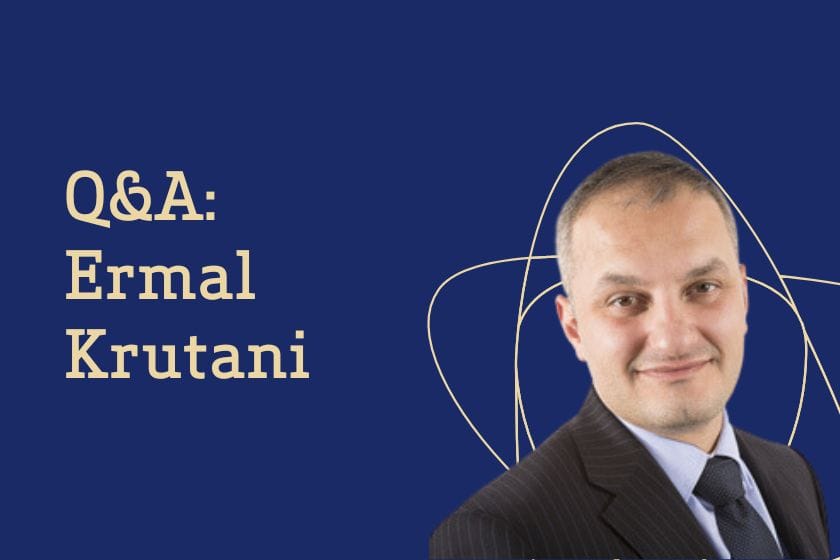
Ermal Krutani has never been one to shy away from a challenge.
“You have to set a daily target for yourself and overcome any challenges on the road to reach that goal. Once that’s completed [you need] to rest and start again. That’s how you progress in your career and in life generally,” he says.
Just last week Ermal shared these words of advice with his son on their drive to school, before sitting down to speak with Financial Accountant.
“I’ve had many challenges in my life, but I’ve learnt from every single one of them and always viewed them as opportunities to grow.”
We spoke about some of his personal and professional challenges, how he’s navigated his way through these hurdles, and what he’s learnt along the way.
Q: You moved to the United Kingdom when you were 21, before starting at Devonports LAS Accountants a few years later. How did you enter the world of finance and accounting?
I grew up in Albania, and began studying accountancy and finance at university there. I then moved to Italy for a year and a half before immigrating to the UK in 2000. When I arrived in England I continued my studies with the AAT, and while I was working at a restaurant I met Ian Hornsey, who is now my business partner. I asked him for work experience and he was kind enough to take me on board. Within two weeks he offered me a job as a junior accountant.
At that time, Devonports was a small practice – Ian, myself and a part-time secretary. Around five years later, in 2005, I started using my connections in the Albanian community to build my own client base and, in 2014, I became a company director. Now Devonports LAS is a business of 45 employees supporting more than 3,000 clients from three offices in Essex. It’s been an amazing journey!
Q: You hit the ground running as an accountant and in business. Did you encounter many challenges when adjusting to life in a new country?
My immigration status was an ongoing challenge from when I first arrived in the UK until I became a British citizen in 2010. Those 10 years were difficult for me as there were long periods when I couldn’t return to Albania to see my parents.
But I had to carry on living my day-to-day life and concentrate on the things I could control. I’m a firm believer in the idea that if something is outside your remit of control, then there’s no use in worrying about it. My immigration status was in the hands of the government so I tried to concentrate on work and gave 110 per cent of myself to improve my own performance and grow the business.
I’ve always derived a lot of satisfaction from helping other people, so I focused my attention on that. My greatest satisfaction isn’t sending someone a fee and bringing revenue in for the business, even though that is the business goal. For me, it’s more about knowing that I have helped to resolve a client’s situation. The even bigger prize is seeing how much clients appreciate our work.
Q: Knowing how much clients value your work must be very motivating. How did you develop your expertise as an accountant in those early days?
Ian has always been a great mentor. I’ve learnt a huge amount from him, and he invested in my learning and development.
In my early days at Devonports, Ian sent me to another accountancy practice so that I could get exposure to another way of working. I received some feedback there that really stuck with me and shaped my whole approach to my career as an accountant. I had been working there for a few days when I sat down with the principal of the firm to go through some of my work. The principal asked me a couple of questions and I said, “I forgot to do that”. He asked, “Why’d you forget? In this job, you’ll succeed if you don’t forget”.
I didn’t take his comment as criticism, but instead as useful feedback that would teach me a valuable lesson. I started reading widely on how to improve your memory.
I’ve read a number of books and articles on the topic. The Memory Book: How to remember anything you want by Tony Buzan helped me immensely. I would recommend doing your own research on memory improvement as [having this knowledge] really does help in progressing in your career.
Q: Aside from memory, what other skills have you found critical?
You need strong communication skills with people, whether it’s with your clients, colleagues or suppliers. You also need to have effective communication skills with relevant government bodies, such as the HMRC, and view them as business partners.
Open communication is critical and that’s what’s helped Ian and I build our business. He’s my best friend but it hasn’t all been sunshine and roses. We’ve had our differences of opinion but we’ve always worked through them. The main question we always ask is: Is the decision for the greater good of the business? The decision might not be good for me at the time, but I understand that the decision must be for the benefit of the future of the business.
We all bring something different to the table, and everyone’s opinions matter. That’s how we have grown our business, by listening to and learning from each other.